Showing posts with label Agenda 21. Show all posts

Wednesday, October 21, 2015

Agenda 21: Baby-Eating Demons

Agenda 21, pp. 202-204

Emmeline opens the door to the Village, and is immediately greeted by the terrifying sound of...gossip.

"So she's here tonight?" one said. She talked through her nose in a high, whiny voice.

"Sure enough," said another, and the light bounced up and down.

"And you met her?"

"Didn't exactly meet her. Joanhad her come in. For an interview." She said interview like it was something to make fun of.

Yeah, and did you see the shoes she was wearing? As if.

This high school drama trash talk goes on for awhile longer. It's clearly meant to be creepy - to give the impression that Emma isn't safe here - but again, surly is not scary.

And then it takes a turn from silly to...well, remember the pregnant woman from earlier?

"One was born today. That's what I heard from Human Health Services."

"And? Was it viable?"...

..."No. Crooked foot. Turned way in at the ankle. Too bad. A boy. Took him straight to Re-Cy."

Execution of the disabled. Harriet Parke went there.

*sigh* I predict that this one runs long.

Remember that Slate piece about this book that I linked to a while back? I'd like to quote from Sarah Cypher, who wrote it (emphasis added):

If the book had been published under Ms. Parke’s name alone, it would remain an entertaining dystopian novel. The writing is capable, the story compelling, and most of its values are to be respected — family, localness, and a good education in history (Beck, and his publishing house, ought to take note of that, by the way).

Here's the problem with that: "Family is to be valued" is not a central theme of this book. "Liberals hate families" is a central theme of this book. The "family values" content is always delivered in an accusatory sense, as part of an Us-vs-Them mentality. We value family, they value power.

And infanticide. Support sustainability initiatives? Then you must also either support systematic murder of the disabled or - most generous reading possible - be gullible and weak-willed enough that you could be talked into thinking it's okay. That's what Harriet Parke is saying here.

As a novel, Agenda 21 is cold vomit. The dialogue is stilted and terse. The characters are one-dimensional. The setting is dull and poorly planned, with inconsistencies and retcons throughout. It's full of long, repetitious expository sequences at the cost of action or genuine drama. There's simply no defending this thing from a literary perspective. At the same time, the overall plot is so absurd and nonsensical that it can't be taken seriously as a cautionary tale. Nothing in this world would work the way it's described; it wouldn't even fail to work in the way it's described.

This is officially the point where I quit trying to stay neutral on the politics, because that's all we're going to have from here on out. Really, we can only consider Agenda 21 for what it is - and what is that, exactly? I'll let Glenn Beck's afterword note lay that one out:


[Parke] realizes that many people don't want to read a long story in a newspaper or watch a two-hour documentary about a topic like Agenda 21 - but they might read a novel...

...If your eyes are now open to the reality of Agenda 21, then I ask that you please pass this story on to a friend - maybe even someone who would otherwise never read about some obscure UN program. Don't tell them about this Afterword. Don't even tell them that Agenda 21 is a real initiative. Let them go through the discovery process themselves.

It's propaganda. This book - like so many others in recent years - was not written for love of the craft or out of a desire to tell a story, but out of a wish to push the author's politics. With a book like this, there's simply no point in trying to separate the message from the narrative. They were unified from the beginning.

Look, I'm not naive. Literature - especially of this type - is inevitably influenced by the author's personal beliefs. The pre-apocalyptic chapters of The Fabulist feature any number of recent hot-button issues, including electronic surveillance, police militarization, and government-private dealmaking. Obviously this is informed by my own beliefs, I'd be lying if I said otherwise. However, these elements are just the backdrop for the story I wanted to tell. The cameras and biometric trackers, the corporate spies, the trigger-happy cops - these are all meant to show that Something Is Wrong, and I never wrote the story with the intention of tricking someone into a "discovery process."

Hell, I'd argue that The Fabulist has the theme of "family is to be valued" and what's more, I got it across without suggesting that people with whom I disagree are baby-killing monsters. But I don't have any famous friends to tell their fans to buy copies, so I have to resort to shameless plugs - like this one.

Next time: Something poorly written and offensive, no doubt.

Monday, October 19, 2015

Agenda 21: Power Dynamics

Agenda 21, pp. 198-202

I decided to turn right.

The significance of this line is that David made a special point of the fact that the compound is circular, so you can go either direction. That was worth noting in two chapters, right?

This chapter covers Emmeline traveling to the Village. Travel segments are inevitably the most boring part of any story, and most writers would recommend a quick segue from location to location. On the other hand, given how few exterior descriptions we've had thus far, this otherwise uninteresting section does show me that I've been wrong about the layout of the area. Several Compounds are present inside a large fence - they are not self-contained as I've been assuming, though they are still spaced very far apart.

Speaking of which, did you know that seeing the term "sprawl" in a statement is an early warning sign that the fascists internationalists bad dudes are taking over your community? I learned that from Glenn Beck.

A few things happen on this little trip. First, we get a good look at Randall, David's not-so-trustworthy messenger:

As he leaned against the gate, I realized he was trying to stand straight, trying to hide the fact that his left leg was shoreter than his right. And when he talked, the left side of his mouth didn't move the same as the right side. And his left eyelid drooped a little. He was not a perfect Citizen.

I think there might be a point buried in here, but it's so subtle that I can't quite catch it.

We also learn that the protagonist is expected to lock up her bike, which seems odd in a society where no one really owns anything. Oh, except their is a reason:

...I didn't want anyone to download my energy into their cycle or storage bar.

Uh...okay, we definitely need to address this "power bike" thing. First off, here's what a human-powered generator looks like in real life:

Photo courtesy of David Shankbone / Wikicommons


You'll note all of the electrical equipment that needs to be affixed to the bicycle to make this at all practical. Apparently, this is all strapped to the bikes in the story universe, which seems a touch impractical, particularly in that the bikes are still meant to be used for transportation.

But I've also been doing just a tiny bit of reading on manual power generation. Wikipedia claims that a "healthy human" (read: not a cyclist) can generate 75 watts of power for a total of eight hours. That's a little more than 2 megajoules, or about the amount of energy that one square meter of open ground receives from the sun in a little over half an hour. Basically, a handful of low-efficiency solar cells could outproduce this entire community, so why aren't we using those again? Couldn't be bothered to think of a reason? Well, maybe in the sequel.

I'm not going to get into the logistics of what were called "download bars" until this chapter, as that gets into electrical engineering and I'm not going to try and bluff my way through that. The insistence on treating electricity as though it were a fluid and not something that needs to form a circuit is certainly something that could be examined, but not by me. There's plenty more coming, believe me, and there's no point in fixating now.

Friday, October 16, 2015

Agenda 21: Hot, Hot Expository Action

Agenda 21, pp. 188-197

Chapter 30 is ten solid pages of exposition. The good news is that once it's done, we'll head off to the Village for the book's final act. The bad news? At this point, you can probably guess what's waiting for us at the Village. But we'll mount that hill when we get to it.

I'd like to take a different approach to this chapter. When I do these updates, I usually focus in on a small part of each portion of the narrative - skipping around, omitting things that don't really matter, that sort of thing. This time, though, I'd like to show off every moment of this wretched chapter with a description of everything that happens in order. Ready?

Well, tough - we're already this far...

  • 188 - More mooning over how sexy David is.
  • 189 - David mentions that the Emma's mother was a Sunday School teacher; she doesn't know what this is because mom was such a wonderful teacher.
  • 190 - More about church and how awesome it was.
  • 191 - The next door neighbor is giving birth. This was mentioned in a previous chapter but it's only here to set up a truly repulsive plot point that we'll get to later.
  • 192 - We get an explanation for that "I wonder where David is?" nonsense from earlier. That guy was sending a message on David's behalf. David says he doesn't trust the guy, which obviously made him ideal for the job.
  • 193 - The new uniforms arrive.
  • 194 - Emma worries that she will get lost on the way to the Village.
  • 195 - David describes the layout of the compounds. Yes, we're getting this now for the first time almost two-thirds of the way in. No, it's not a good description.
  • 196 - Some stuff about the Gatekeepers and how they're assholes (except for sexy David, of course).
  • 197 - "I wish I could say that everything went well...But I can't. Time and events pushed us forward in ways I never could have imagined." This is a lie. Spoiler alert: Every part of Emma's plan goes perfectly and she is never in any peril for the rest of the novel.


So that's what a chapter looks like. Next time, we'll get out of this boring gray box and head to a place where things will happen. Warning: I might be lying.

Wednesday, October 14, 2015

Agenda 21: The Sexy Part

Agenda 21, pp. 182-187

I realize it's bad form to do two chapters in one update, but sometimes there's really no choice.

By now, I'm sure your eyes have drifted to the page count at the top. Yes, Chapter 28 is a mere two pages in length, and Chapter 29 is just a page more than that. If you've forgotten, these are the large-print edition pages, so these two chapters together are scarcely over a thousand words. The chapters in the last third of the story get really short - yet another serial-like aspect of the story.

But enough talk about chapter lengths. The important part is that this is where Emmeline and David do the nasty. Aww, yeah.

Chapter 28 is an extremely terse description of a pairing ceremony, followed by the nasty-doing that we've been building towards for nearly a hundred pages. It's obvious that Harriet Parke is uncomfortable writing explicit sex scenes and/or concerned that her readers would be uncomfortable reading them. The way you handle this is with a fade-to-black - a scene that attempts to maintain heat while stopping just short of the squeamish parts. Here's what that looks like in Agenda 21:

We spent the evening of his new sleeping mat, twined around each other like vines on trees. Later, much later, we ate our nourishment cubes.

Uh...hot?

The following chapter is there mainly to give us a glimpse into our very dull protagonist's very dull post-coital bliss. However, it does hint at what's to come:

"I used to hear Mom and Dad talking about your mother...She was George's teacher. Father told me that. And some things I didn't understand. Things about laws changing...Laws about animals. Laws about who owned the farms. Laws about energy."

Oh, don't even try and tell me that you weren't missing the exposition.

(In honor of these very short chapters, this is a very short post. That's the real explanation - it has nothing to do with the fact that I don't care to dwell on the queasy sexuality that runs through these pages)

Monday, October 12, 2015

Agenda 21: Short, Silly, Dull

Agenda 21, pp. 176-182

Another chapter, another trip into mother's sleeping bag of holding. This time, it's going to pay off in dividends, dispensing with three objects. First up:

A strange little book. Red leather, cracked with age, its cover lettered in faded gold. The New Testament.

Actually, it's just the Gospels, so I guess this is meant to be one of those pocket editions. This comes as a total mystery to Emmeline, whose mother apparently never told her about that Old Time Religion. What kind of teacher was she, anyway?

The next object is a switchblade. No, seriously:

It was a strange object, obling in shape, only about three inches long, and made of metal. I pushed a small button on one side and a blade snapped out.

Perhaps this is a holdover from mom's younger days in the mean streets of central Kansas. Elkhorn's a tough town, let me tell you.

The last object out is a box of matches, which isn't interesting enough for me to describe.

Actually, nothing in this chapter seems to be worth describing, at least from the author's perspective. It feels odd to say this, given how vocal I've been in opposition to the extremely verbose descriptive passages that define modern novels, but here goes: Parke needs to use more than one word to describe some of these things. Remember that joke I made about the coin seeming like an egg because the same two words were used to describe both? Well, here's how our protagonist describes the knife:

Hard and cold.

Then she cuts herself with the knife:

...slick, wet, red.

And the matchbox?

...small, square, smooth.

This is beginning to annoy me. I would be willing to play this off as an artistic choice were it not for the fact that the author drops it when describing certain things, such as how hot the pool boy David looks in a t-shirt.

It occurs to me that there was a Chekhov's Knife of sorts floating around in The Fabulist. Now what did that look like?

It was actually a fine piece - lacquered grip, animal horn hand guard, ornate symbols etched into the steel of the blade. Once upon a time, such a knife would have fetched a handsome price, but in the new world it was little more than a shard of metal with a keen edge, no better or worse than any blade of similar size.

Incidentally, here's the real-life piece that inspired that description:


In retrospect, I don't know why I bothered with that when "long and sharp" is sufficient.

Friday, October 9, 2015

Agenda 21: The Parable of the Artist's Prison

Agenda 21, pp. 171-176

STORYTELLER: Hello, friends. I'm sure that my presence, unexpected as it is, is perplexing to you. It was never my intention to hijack this commentary, but the creator left unexpectedly and put me in his stead. He gave no instructions, save that I read the following without omitting a word:

"Chapter 26 is a waste of time. Emmeline regains consciousness at the Meeting, arousing no reaction from anyone else there. There is no pairing ceremony. Later, she learns that the special ceremony was ordered by an Authority who was overstepping his boundaries. Aside from raising a few questions about the Republic command structure, this chapter does nothing but completely defuse the earlier tension by telling us that David is okay, something that could have been revealed in the next two chapters where it would actually make sense. Therefore, I have decided to leave this update in the hands of another of my characters and return in the next chapter when there's something worth dissecting."

An unusual development, you must admit. My normal response to such a request would be a story, so I have opted to pen a quick tale that I believe is appropriate:

Once, there was a painter who lived in an old kingdom. He was a man of small talent, smaller repute and smaller still wealth, but he had ambition to create a work that would last the ages. Time and again, his colleagues were commisioned to paint works while he was left to sit in his cottage and dream of everlasting fame.

Finally, his day came. A messenger from a local lord rapped on his door with an amazing offer. "My master wishes for a painting to reflect the glory of his kingdom," said the servant, "and we are willing to furnish all of your supplies and attend to all of your needs. This is a most challenging task, one that many others refused for lack of drive, but the rewards are great." The painter loved the sound of that last line. How he longed to show up the others who had made him feel so small! He eagerly accepted the offer and departed with the messenger.

As the lord's fief came into view, the painter learned why this task was deemed a challenge. It was a wretched, colorless patch of mud, crowned by an ugly cluster of villages. It had the look of a tract set aside for a most unexceptional man. However, he perked up when their carriage reached the castle. His quarters in the estate were magnificent, decked out not only in creature comforts but well-stocked with fine brushes in every size and oils of the highest value. The painter eagerly tackled his task, sure that his new tools would allow him to finally paint his masterpiece.

The only outlet to the world was a window looking out onto the wretched earth, so the painter dug into his imagination. Days turned to weeks and to months as he labored over his work. He never departed his quarters - food, wine and supplies were delivered to him on demand by servants who never spoke or made a sound. But despite the perfect circumstances, the masterpiece never formed. With each failed painting he shredded, the painter cursed his luck. The task was impossible - a he simply could not make this cursed place seem grand.

But when the painter turned to depart, the door refused to budge. In his fervor to begin, he had not noticed the locks on the door. From the other side, the painter could hear a voice: "A deal is a deal. Finish the task and you will be rewarded and released." The painter replied, "Even a true master could not draw beauty from this place." "As though you would know of mastery!" returned the voice. "A true master could draw beauty from anything, but he would never be fool enough to shackle himself to a place such as this. Now, return to your task, lest you make of this chamber a tomb!"

The moral of the story? Art that is not its own master soon becomes a slave to the artless.

Ceci n'est pas une plug.

Wednesday, October 7, 2015

Agenda 21: Serial Offender

Agenda 21, pp. 164-171

The next part of the novel is a weird little vignette in which Emmeline quarrels with a mad old crone. I'd thought about skipping this part - it's superfluous, it actually makes less sense in context than out, and there's not a lot of informative value to be drawn out of it. On the other hand, skipping it would mean skipping the whole chapter as, aside from Emma finding the coin on page 163, nothing else happens. So, in the sake of competeness, here we go.

Here's the abridged version: Emma goes outside to find that the woman next door has stolen her morning rations. The woman, who is clearly disturbed, insists that the food is for her children who are coming for her. Eventually, a Gatekeeper shows up and ends the argument. Later, a group of officials come by and take the woman away to parts unknown. Right before the big Meeting, they take the crazy woman's husband away as well.

So why is this here? That's a good question. The one thing I can say in defense of this passage is that it was established before now - previous chapters mentioned noises from "Living Space 2" which is where the crazy lady lived. That does little to answer the "why" part, though. It seems like it might be meant as some sort of object lesson in how life in the Republic changes a person, as evidenced by passages like this:

I was safe. But she was not. What kind of a person had I become, glad that an old woman would be reported instead of me?

But really, this whole subplot is yet another element of the novel that makes it feel like a serial. In serialized fiction, it is not always possible (or even wise) to stick to a nice, neat, linear narrative. Occasionally, you have to divert in order to keep the story moving forward. These diversions rarely have much to do with the proper story, they're just present to keep the momentum going. I've done this myself - the original serialized version of The Fabulist had several one-off subplots that were wholly detatched from the main story. In one chapter, Storyteller had an extended conversation with a megalomaniacal raider who was trying to build his own city by tricking people into coming to an encampment and trapping them inside. That character was dead by the end of the following chapter. There was no point to that subplot - it was there because it was interesting.

You may notice that nothing like this subplot appears in the novel version of The Fabulist. Well...aside from being pointless, that kind of thing can break the flow of a novel. A novel that a person might read in a few sittings can't afford to meander like a serial that's meant to be read over a period of months.

This whole chapter has that weird serial feel. It even has a passage in which the protagonist recounts the people with whom she had attended the previous Meetings, as though I had read those chapters months ago and needed a refresher. Not knowing the history of this narrative (and not believing the official Glenn Beck version), I really can't speak to this aside from warning you not to do it yourself.

There is one more serial-like aspect of this chapter - it ends on a cliffhanger. At the meeting, John says this:

"There's been a change of plans."

Then Emmeline collapses. Ooh, drama!

Monday, October 5, 2015

Agenda 21: Wordplay

Agenda 21, pp. 159-163

You know what's sad? When you unveil something new and then realize after the fact that you jumped the gun.


Chapter 24 is just four pages long - only around a thousand words - and yet it feels so much longer because the entire chapter is the protagonist thinking about things. She thinks about Else. Then she thinks about her mom. Then she thinks about David. Then she thinks about David some more. Then she goes to sleep.

The only important thing that happens is this:

The new Gatekeeper stopped outside my door...He stood outside my door for a long minute, then said, "I wonder where David is. Yes, indeed, I wonder where David is."

Now, what just happened - having a nameless, unestablished ancilliary character talk loudly to himself - is easily one of the worst means of introducing a plot point I've ever seen. Nevertheless, I'm tempted to give the novel a pass on this one. You see, this isn't going to be resolved at the end of the chapter, or even in the next one. Halfway into the book and Harriet Parke has finally learned the rudiments of dramatic tension.

This "learn as you go" thing is another bit that makes this novel feel like a serial, specifically one done by a first-time author. A serial is essentially a first draft being published in real-time, and irregularities are bound to crop up due to the quick pace. Of course, by the time those serial chapters are edited together into a novel and published professionally, it should no longer have that feel.

That was short and stupid, so how about a bonus? We open Chapter 25 with another trip into the sleeping mat o' wonders:

[I] felt something else. Something small, smooth, cold, round. I pulled it out slowly. A golden color. An image of an Indian on one side.

The first time I read Agenda 21, I got to this passage and wondered, "Why did she have an egg with an Indian face in her secret stash?"

That sounds like a joke but it's really about half-serious. Harriet Parke is not exactly a wordsmith; "smooth" and "cold" are the same words she used to describe the eggs in everyone of those bizarrely long egg-eating sequences, with "golden" describing the yolk. Every time. On seeing those words pop up, my brain immediately went to "egg." That's how bad this novel is - it actually screwed with my cognition a little.

Oh, and the elephant in the room - How does someone who didn't know what a state was until a few days ago know what an Indian is? And would a person born that late even be familiar with that nomenclature?

Friday, October 2, 2015

Agenda 21: Filler

Agenda 21, pp. 152-159

I got tired of just writing this out, so I decided to take a few minutes and whip up a quick graphic. Ready?


Of course, I'll still try to make this interesting.

We open with a weirdly hostily little exchange between Emmeline and the Gatekeeper:

"Your special job hasn't started yet, you know."

I nodded again. He didn't have any facial hair. He talked like Jeremy, and he looked to be about Jeremy's age...

..."[Jeremy] didn't like you," he called out. "You're one of thos home-raised. Note like us. He told me about you. He told me about you waking up early. So there."

Having seen the Children's Village, does this characterization make sense anymore? I don't know - the detached and cold environment seems like it would produce something closer to the dead-eyed moppets of Brave New World. It's pretty typical for dystopian novels to feature scary youths, but surly =/= scary. Perhaps I'm just a few decades too young to realize how chilling back-sass is.

Next, John drops off Emmeline's energy bicycle and shows her how to hook it up (via hose - to capture all that electricity juice, presumably). Then, in true tell-before-telling-some-more fashion, some government officials turn up and inform Emmeline that she's going to be paired off at the Social Update Meeting, which we were told about several chapters ago. ARE YOU ON THE EDGE OF YOUR SEAT YET?

Then something happens that actually is unusual for this book - description of our surroundings:

I rode in a circle past all of the Living Spaces in our Compound. Twelve Living Spaces here at Re-Cy. Other Compounds were larger or smaller depending on the number of workers needed in those workgroups. Our individual worlds were small and fenced, under the dark umbrella of the all-controlling Republic.

Take a look at the page count. We're at Chapter 23 of 49; in terms of pages, we're not quite halfway through. We're just now description of the area in which the entire story takes place. And just look at all the details that aren't here.

As is so often the case in this book, this little stump reveals a lot. Twelve Living Spaces means that there are twenty-four people here, plus an indeterminate number of Gatekeepers who live separately. The last few chapters were vague on the number of children, but there were only three infants so the number of children in the Village is presumably less than the number of adults. This entire compound probably has fewer than fifty people in it. If you pictured a few hundred people at the earlier meeting - as I did - then you were really high.

This is a significant hint in our quest to figure out the size of the Republic. It also makes the Republic logistics seem even more absurd - imagine what their power grid looks like if every settlement is under a hundred people and spaced a few miles away from everything else. And for the more detail-oriented, it also raises questions as to whether this tiny compound is even capable of sustaining itself.

(Future me: Actually, hundreds of people might be right. There are more details about the layout of these compounds that - naturally - won't be revealed for a few dozen pages. We'll deal with that when we get to it)

But that's not the part I noticed. After all, didn't Emmeline just break a rule in front of everyone? I know I read this somewhere...

...all transportation had to be approved by the Authority. No Citizen could walk freely because that was an expense of energy that could not be afforded. (pp. 23)

This ridiculous policy is the excuse as to why we didn't get a good look at the compound during the first half of the novel. And yet Emmeline is now riding around in violation of that rule. She actually does get stopped by a Gatekeeper. She tell him that she's "practicing." Then she rides around the compound again.

I bet you thought I was exaggerating when I said her main goal is "Get caught," didn't you?

Wednesday, September 30, 2015

Agenda 21: A Better Class of Person

Agenda 21, pp. 146-152

We continue our tour of the Village with the classrooms:

"The girls' classrooms are on the left, and the boys' on the right. The Central Authority mandates gender segragation after infancy, and you should abide by that rule as best you can in dealing with the children."

Makes sense - we all know how vocal deep greens are about single-gender classrooms.

We get a little bit of information about what's taught in these classrooms - walking on energy boards, saying pledges, and regulations. I suppose that is all you'd need to know in this society, though I'm not sure how it takes ten years to learn it all. We also get this little vignette:

One of the boys, a smaller child with blond, spiky hair, was making the circle sign on his nose instead of his forehead. He was grinning, enjoying the farce. His Caretaker hit him sharply on the back of his head. He quickly put his hand to his forehead, and the look on his face made me think of a candle that had been snuffed out.

So remember that farming village in Jilin? While I was working there, I saw a teacher kick an eleven-year old girl. Once again, this dystopian hellhole school fails to impress me. Of course, most people aren't going to have this perspective.

Incidentally, this is why the dystopian writer's curse never bites as deeply as the science fiction writer's curse. We all had a big ol' laugh at Back to the Future Part II because we all know what the year 2015 really looks like. But how many people have been close enough to a war zone to realize that the nightmare future scenario is actually pretty tame?

The final stop is the nursery, and I'm going to take a pass on the big mother-daughter reunion for now. Trust me, there will be plenty of time for that once Agenda 21 turns into a Hallmark Special Edition in the third act. We do still have a few more points to touch on before we leave the Village. For instance, we still have to meet the Aunt Caretaker:

She came out, carrying an armload of diapers. She looked at me without smiling and began placing the diapers on the shelves under the bassinets. "Don't wake up a sleeping baby, you hear?" she said.

I bet she's really nice and will be very kind and understanding towards Emmeline.

One more point worth highlighting: Why is it that everyone is so willing to send their children off to what are essentially Dickensian orphanages?

"First of all, the Social Reorientation has been very through and the Central Authority persuasive. People needed something to believe in, so they believed in the leaders. They repeatedly said that the children would do better if raised by the Authorities. That message was hammered into the people. They heard it over and over until it became truth to them."

This should be a major plot point. The way that this society treats parenthood is such a major deviation from the real world that it demands careful consideration. Keep in mind that all of his happened not just within a human lifetime, but within a single generation. And yet this is all we're going to be told about it. Most people are just stupid sheep; Only the parents of good Mary Sues and Gary Stus knew better.

That may well be the essential message of not just this novel, but every politically-oriented dystopian narrative penned with the last few years: By reading this, you have proven yourself better than people who have not read this.

Monday, September 28, 2015

Agenda 21: Emma Sue

Agenda 21, pp. 143-145

Chapter Twenty-Two includes more exploration of the Village, such as a scene of children in the play area singing this oh-so-clever variant on a classic children's song:

Every day I walk my board
Walk my board
Walk my board
Every day I walk my board
For my fair Republic

I realize that this is meant to be creepy, but all I thought as I read it was "That last line doesn't scan at all."

Aside from a new setting, there's one other thing that this chapter brings to the table - character motivation. One of Vonnegut's rules is that every character should want something, but Emmeline hasn't exactly been keeping up her side. For most of the novel thus far, she's been a passive little tabula rasa waiting for someone else to tell her what to do. By this point, however, she has a few motivations. Here's a rough list:

  1. Find Elsa and, if possible, take her out of the Village;
  2. Hot sex with sexy David;
  3. Escape from the silliest dystopian city ever.

Given her behavior over the next few chapters, I think there's another item that belongs there:

  1. Get caught.

Seriously, if Winston Smith had taken this many meaningless risks, he'd have been in Miniluv around page 10. Here's an early example:

"Your responsibilities will include hourly rounds on all the children. Between rounds you'll be stationed in the infants' area."

"With Elsa," I finished.

Now I know what you're thinking: "This isn't a risk. Joan is a friend." Except not five pages earlier, we had this:

[Joan] didn't look at John and he didn't look at her. That must be something that can be monitored.

So Joan was careful not to look at her husband because that might somehow give away the game, and yet we now have Our Capable Protagonist openly discussing the daughter she isn't supposed to know about. Did I mention that, as she altered records, Joan is neck-deep in this and will also be in peril if Emmeline is caught?

Not that it matters, as Emmeline is our Mary Sue and they're never in any real danger.

The literary term "Mary Sue" (sometimes masculinized as "Gary Stu" or "Marty Stu") is thrown around a lot when discussing bad writing, but it's misused more often than not. The term originates in the fanfiction community, where it refers to a type of wish fulfillment character who is connected to all of the official in-universe characters and yet is more important than any of them. The term later found its way into the world of original fiction, where the meaning is a little muddy. People define the term in a lot of different ways; some argue that it has become too broadly defined to be of any use.

To use the most widely accepted definitions: A Mary Sue is a type of highly idealized character - preternaturally skilled, beloved by all (except the villains), and critically, centrally important to everything that happens in the story. S/he is often (but not always) an authorial self-insert, a character meant to represent the author in the story. As a character loved by his/her inventor, a Mary Sue faces no setbacks and no problems that rise beyond the level of nuisances. Above all, the Mary Sue is unique, better than everyone else and unbound by the normal rules.

Let's look at Emmeline. She is consistently depicted as being better at her peers by dint of being "home-raised,"* which is very rare. She has had no real obstacles - all of her problems have been defused in a paragraph or two without so much as a trace of sweat. Most telling, her entire current circumstances - where she is working at a special job while also being married off to a normally chaste Gatekeeper - is a result of a special dispensation. That's right - the evil, tyrannical, mindlessly inflexible future government is breaking its own rules to make Emmeline happy.

"But what about those first few chapters?" I hear you say. "She faced plenty of adversity there." Par for the course, my friend. Remember that those were flashbacks, events that had already come to pass. It's actually not unusual for a Mary Sue to have an arbitrarily traumatic background. Some of them get really grim - Emmeline's history is tame compared to some of the blood-soaked Mary Sue backstories I've seen. Giving the Mary Sue a tragic background is an easy way for the author to gin up some sympathy for a character s/he wants everyone to love. Everything that happens in the present time of the story is smooth sailing. And by the way...


...that's going to be true here, too. It doesn't matter how many times Emmeline acts insubordinate, or speaks out of line, or lets slip something she shouldn't. Nothing bad happens, because she is protected by the power of plot. The plot doesn't call for Emmeline to be dragged off, so she won't be, and that's simply the state of things.

*  *  *  *  *

*Yes, it was "homeschooled" earlier. It will be "home-raised" for the rest of the story. This book was professionally edited and published under a major imprint.

Friday, September 25, 2015

Agenda 21: Petty Nightmares

Agenda 21, pp. 139-143

You might not realize it, but I took a behind-the-scenes break from Agenda 21. This update begins a rather significant shift in the story, and the last thing anyone needed was to have me tackle that while worn down from writing/transcribing a couple ten thousand words about this crap.

So...Children's Village:

The packed-earth paly yard was empty of children again, its toy energy boards lined up. A woman in a white uniform waited by the main door.

The woman is John's wife Joan, who has been our inside man for the last few chapters. Joan, we learn, has been reclassified as a "Supervisor." Oh, don't go digging back for the updates for those lists - Supervisor is actually a new position, recently developed by the Authority.

That's a small point, but an interesting one. Anyone who has worked for a real-world corporation knows that they love supervisors, with the ratio of supervisor to underling falling to 1:6 or less. It really suggests that these compounds are tiny if they haven't needed any local management until now. Of course, as we discussed earlier, the Republic is such a paragon of unearthly efficiency that perhaps they have no real need of such employees.

Next, we get a description (of sorts) of the Village:

I followed her into the building, down a long, dim hallway and into a room she called her office. She closed the door.

"Have a seat." She motioned to a chair. It looked flimsy and creaked when I sat down. Her desk was small and the surface scratched.

The horror of old, somewhat damaged office furniture! Can you fathom a future in which your workspace is less than pristinely adorned?

"The night shift staff works the pink rooms, the blue rooms, and the nursery."

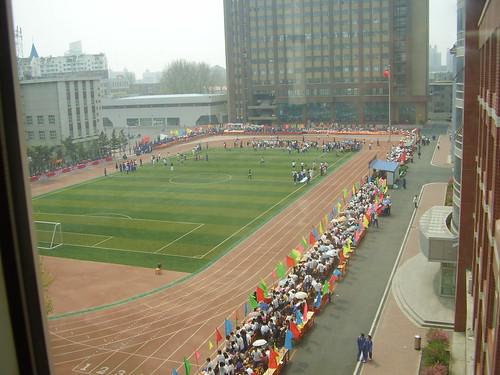
As with the rest of the book, the description leaves something to be desired. I envision a building I saw in a farming village in Jilin Province. While they had a proper school building, it was only large enough to accommodate the high school students. The junior high classes were held in another building on campus - a single-story concrete box that didn't even have electricity in every room and was so poorly-maintained that my messenger bag ended up with a permanent discoloration from the dirt. That was how I saw the Village the first time I read this thing, as the book was setting me up to view everything as really decrepit. That's not really present in the text, though, and on this readthrough I'm seeing a structure much nicer than the one in my head.

Spring in Changchun 1
Not that school, though illustrative in its own way. Did I use that joke already?


This is one of the curses of this particular subgenre. Earlier, I mentioned the science fiction writer's curse, in which setting your story at a specific future date inevitably means you'll be judged on your accuracy - regardless of whether or not you were actually trying to predict anything. Dystopian writers don't have that problem as their stories are meant to be cautionary, but they have a curse of their own - whatever world they create needs to be in some way worse than someplace that already exists. Harriet Parke tried so hard, but I don't think she quite pulled it off.

Wednesday, September 23, 2015

Agenda 21: The Story So Far

Agenda 21, pp. 128-139

We're going to autopilot over this next part. While it sets up the second half of the book, it does so in an unnecessarily ponderous way. Here's what you need to know: Emmeline is going to be sent to work in the Children's Village, and it is implied that she's going to be paired off with sexy David though we won't know for sure until later.

The problem is that the novel takes a rather circuitous path to reach this turning point. Here's what happens: In Chapter Twenty, John tells Emma what she'll need to do to get into the Children's Village. Then, in the first part of Chapter Twenty-One, Emma does exactly what John told her to do and achieves the predicted end - no complications, no tension, just a convenient plot device.

All you need to know is that the protagonist is being reassigned. You miss nothing except some scenes of the protagonist eating eggs that are growing so frequent and vivid that they border on the fetishistic.

Since we are nearing the midpoint of the novel, and since we're about to be introduced to the plot proper, this seems like a good time -

AARON: Take a little more to set this up, asshole.

ME: ...Right. I've invited a character from my own works, Aaron Bellamy, to help me with the recap.

AARON: "Invited" me, huh? That's one way to gloss over the fact that you're talking to yourself in this post. Not to mention that you're less than halfway to freedom and you're already leaning on gimmicks.

ME: Aaron is here to provide a slightly more blunt and earnest analysis, the kind that you would expect from someone who regularly reads science fiction. Now -

AARON: Hold it, I do not read "science fiction." "Science fiction" is all wish-fulfillment crap where the self-insert protagonist totes some ridiculous plasma handgun and has a catgirl lover with four tits. Liston and that fatass friend of his read science fiction. I read speculative fiction, which is serious out literature that explores the possibilities of our universe in a nuanced and well-detailed manner.

ME: Yeah, this was a good idea. Anyway, we've picked up about all the lore we're going to get in the first novel, so we can now examine the world of Agenda 21 in more detail.

In this universe, "Agenda 21" refers to a series of laws passed at some point in the recent past - recent enough that there are many people alive who remember it. Similar laws were apparently independently adopted in other countries in a manner similar to the shift in governance described in 1984.

AARON: Don't compare this thing to 1984.

ME: I didn't.

AARON: Don't even discuss them in the same sentence. Just get to the relocations, because this doesn't make any sense.

ME: Well, at some point the government turned tyrannical, dissolved the existing government and created something called "the Republic" - or something like that happened, anyway. One of their big policies was forced relocation of all citizens.

AARON: Not that this author is going to tell us anything more about it than that.

ME: Actually, she did. John mentions in this chapter that he speculates that they were sent to Ohio, Pennsylvania or West Virginia.

AARON: Wait...why? Why would they take people from Kansas and send them eight hundred miles to Ohio? In the old Communist states, there was always some purpose to forcible relocation, like the central planners trying to populate a desolate area or seeking to quietly eliminate less-than-loyal party members.

ME: Or gathering natural resources.

AARON: Like what? These people aren't mining anything.

ME: Well, soy appears to be their new staple food, and Ohio is one of the top producers of soybeans.

AARON: But Kansas is too, isn't it?

ME: Perhaps the government wanted to move everyone closer to the coasts so that they'd be easier to monitor.

AARON: No, no, no. You already said before that all of these compounds are miles away from each other. What sense does it make to draw everyone to a single location and then scatter them around in the general area?

ME: Uh -

AARON: And why all the secrecy? Why the hell would it be so important that no one know where they were sent? Was the government afraid that someone would memorize the route she took, escape from the compound, and then walk back home through a thousand miles of wilderness? Hell, it's a train - couldn't someone just follow the tracks? The depots would have to be marked.

ME: This concludes our look at the background of Glenn Beck's Agenda 21. Next time, we'll enter the Children's Village and actually get a good look at a new location.

AARON: Damn it, you're not cutting me off! I have more to say! I swear, I'll -

Monday, September 21, 2015

Agenda 21: Dystopia After Dark

Agenda 21, pp. 122-128

Another day, another trip into mom's sleeping mat of many objects:

A book. The Little Prince. My favorite of all the ones Mother used to read to me. I remembered that the author's name...

Yeah, sure - deeply sentimental, still not the target audience. Not that it matters, really. While this may seem like the kind of thing that would form the basis of the chapter (perhaps as the catalyst for yet another flashback), it's actually entirely incidental. Here's the focus of the chapter:

"Emmeline." A whisper filed in through one of the window slits. "It's me. David. I'm outside your door."

Yep, this is the chapter in which McSexy formally joins the regular cast. That means we're going to start seeing passages like this:

David was by the gate. So tall, with broad shoulders, narrow hips, long legs. His dark hair dipped over his forehead and perfectly framed his firm jaw. He gave a little wave without raising his arm, moving only his fingers. There was a distinct moistness in my undergarments.

Okay, I added that last line. Nevertheless, this is pretty much the rest of the chapter, as well as a sizable chunk of any chapter in which David appears. Parke puts far more effort into describing David's physique than she has into any other character, object or place thus far. I still don't know how big these little colonies are or how they're laid out, but I do know how David fills out his uniform ("And so solid, his shirt was taut against his chest.").

Basically, we're into romance novel territory. If that makes you uncomfortable, then I have bad news.

The climax (ahem) of this chapter happens when David comes back after his rounds. This is against the rules, but it's not like anyone ever gets in trouble for that kind of thing. Just when it seems like Agenda 21 is going to turn into a best-selling KDP novella, we get this:

"You and John. You're friends, right?" 
"He's my father."

Of course he is. I'd call this a "bombshell," but why? All of the Good Guy characters have been directly connected. There's no evidence of any similar ties among the rest of the rabble in the compound, but Emmeline is different - she positively has to be connected to everyone and everything.

Which brings me to my next query / project regarding this novel: I want to figure out just how big this compound is. The world of Agenda 21 seems very empty, and yet we keep bumping into people from the protagonist's past. That might still track given the relocation thing, except the compounds seem far too desolate. It seems like the evil future government would want to move people to population centers, but that obviously hasn't happened here. Did they just shuffle these small-town types around just for the hell of it? What sense does that make? And has there been some kind of massive depopulation event to explain where all the people went?

We'll be trying to assemble that from what clues we're given - and there are more clues coming up.

Next time: Auuuggggh.

Friday, September 18, 2015

Agenda 21: Interactive Fiction

Agenda 21, pp. 117-121


An interactive thriller from the producers of THE OVERTON WINDOW


>load

You are in a drab, unremarkable room with concrete walls. There is a single narrow window in front of you, the soft evening light streaming through. There is a map of the United States in front of you.

>fold map

You refold the map, taking a few tries to get it right. These things are a pain to fold, amirite?

>i

You are currently holding a sleeping mat containing an anachronistic photograph, a packet of recipe cards, and a map.

John passes by the window.

>say hello john

"I just wanted to make sure you're okay. Are you?"

>say yes

"Jeremy never should have been paired with you. My wife knew him from the Children's Village. She said he wasn't mature of stable enough, that the Central Authority is pushing the children to reproduce and be productive before they are ready."

>ask about elsa

"She's growing."

>ask about sexy gatekeeper

"Let him know if you need anything. He promised to keep an eye on you to make sure you're okay."

>ask about home

"We used to live in Kansas."

>ask about current location

"We were relocated without specifics, on trains with the windows painted black."

>ask about coincidence

You ask John if it seems odd that after years of being shuffled around the Compounds that you keep ending up neighbors with all the people from your old hometown. He shrugs.

>that makes no sense

Please don't point out weaknesses in the narrative.

>offer map to john

"Maybe I can figure out where we are. Or do you want something for it?"

>say bring elsa here

"Do you have any idea what you are asking for? Give me the map. I'll try to figure something out, but I can't promise anything."

John takes the map and leaves.

>wait

Time passes.

The sexy gatekeeper passes by the window.

>swoon

I'm sorry, I don't understand that command.

"It's very unusual for the Central Authority to allow a female to live alone. They weren't prepared for the move Jeremy pulled. He was a brat, wasn't he?"

>say what is your name

"David. I know yours already."

He takes his leave.

>say can love bloom on the battlefield

He is too far away to hear your cliche video game joke.

You are now alone.

>write better novel

You pen a manuscript with more colorful settings, deeper characters and genuine drama. It draws the attention of a famous ideologue, who conspires to get the rights to it and release it under his own name. You spend the rest of your life trying to figure out why there are people willing to pay Jerry Jenkins for writing tips.

GAME OVER

SCORE: 18 of  49

Wednesday, September 16, 2015

Agenda 21: This is Middle America

Agenda 21, pp. 115-117

Chapter Eighteen opens with Emmeline digging into the sleeping mat of wonders once more. What do we get this time?

It was paper, folded many times. A map. I unfolded it carefully because it was thin and fragile along the fold lines. One side was a map fo the United States of America.

Basically, it's this:

Courtesy of Wikimedia Commons

Kinda boring, all things considered, but maybe there's more:

I turned the map over carefully. On the other side was a map of a state called Kansas.

Oh snap, that's where I am.

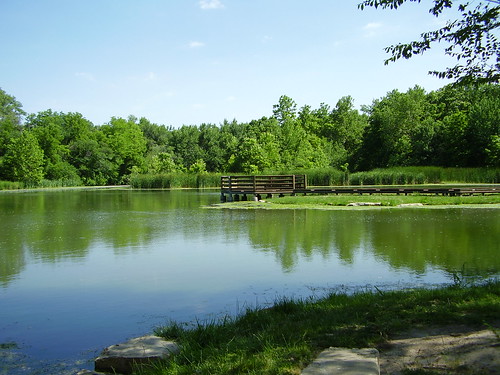
This map is marked and therefore slightly more interesting. The indicated location is Lake Wilson, which is real and looks like this:


There are some rather interesting rock formations in Lake Wilson - plug the name into GIS and you'll get at least a dozen pictures of them at different water elevations. Not that we're going to hear about that, because it would entail describing something. Well, there is a bit of description:

I looked up at the picture of Mother and me. Was it taken in front of our house in Kansas? Is that what the green grass looks like in Kansas? How close to the lake...

Wait a second, green grass? In Kansas? Uh...

I'd like to take a moment to talk about buffalo grass, which is what we have in this state. Plug that name into GIS and you'll get a bunch of images that look like this:

Kansas Splendor 1


That's in a park, a place carefully cultivated by human hands to defy the nature that surrounds it. Now, buffalo grass in the wild...well, it's technically green, but as you can see in the above picture of Lake Wilson, it's not exactly the hybrid bluegrass mix that most people picture when they think of grass. Here's what it looks like up close:

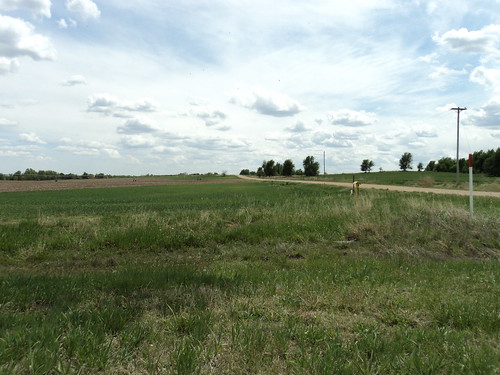
Kansas Desolation 2


Kansas is a semi-arid region - the plush, fragrant, water-intensive grasses that inhabit suburban lawns wouldn't survive a day there. What we have is a coarse, brownish-green grass that will grow past your ankles if you let it. It's rough to the touch and, in unkept areas, it tends to be full of stickers. After a good rain, buffalo grass can acquire some rather remarkable hues, but they tend to be more in the red-purple spectrum - not the vibrant green we're being presented with here.

I will freely admit that this annoys me far more than it should. It's an incidental point, and I'm assuming that Parke has actually been to Lake Wilson. It's just weird, is all. You get used to these alien descriptions of your current location when you like in places like the PRC, but Kansas?

Monday, September 14, 2015

Agenda 21: No Action

Agenda 21, pp. 111-115

You're not going to believe this, but Chapter Seventeen actually has some tension in it. There's a sudden arrival at the door:

"Citizen," one of the Enforcers said, "where is Jeremy?"

"At work," I answered. "At Re-Cy."

"No, he's not. His supervisor contacted us. Jeremy's not here."

As Jeremy is AWOL, the Enforcers are about to search the room. Now, this is a bad situation for our hero. She is, after all, the daughter of a woman recently dragged off for being excessively "antagonistic." There is a large bag of contraband in the room (which she is sitting on to "guard it" - real inconspicuous). And she's been having regular chats with people she really shouldn't be - people she could implicate if she's not careful.

They opened the door to the washing-up area. They glanced into the eating space and the sleeping space. They checked the meter on my energy board. One of them glanced at the new energy cell on my thigh. When they were satisfied that Jeremy was not here, they stood in the doorway and frowned.

And then they leave. That's it.

Even now, halfway through a re-read, I am still amazed by the author's ability to avoid genuine drama. Keep in mind that this comes mere pages after all those ominous notes about the all-seeing nature of the Authority. And here we are, in a situation that would be terrifying in the hands of any capable hack writer, and it's over in seconds. You would have to put in effort to make this scene so painless.

It's moments like this that make me curious as to what the follow-up novel looks like. Without spoiling anything, it places Emmeline in a situation where Parke can't easily sidestep any action scenes that might come up.

The Enforcers return less than a page later, this time with news of Jeremy:

"He was found trying to climb the fence into the Children's Village."


And that's the end of Jeremy - he's taken away to a farm compound and we'll never see him again. Pretty unceremonious, but I can't say that I'll miss him. Unfortunately, this is going to kick off another long chunk of exposition. I can only think of one image terrifying enough to reflect my feelings on that:

Our furry overlords dictate that no action take place. Verify your understanding.

Friday, September 11, 2015

Agenda 21: The Sleeping Bag of Holding

Agenda 21, pp. 107-111

All right, what happened in this chapter besides an excuse for me to go on a rant? Actually, quite a bit. First off, McSexy is back, and this time he's feeling chatty:

"You remind me of someone. She was about your age. You probably don't remember, but you used to play with her. Back at the farm. She liked hard-boiled eggs. She died when the illness came here, and I miss her."

In the sort of cosmic serendipity that blesses all poorly planned novels, all of the Good Guy characters were good friends in the Long, Long Ago Time. Of course, that raises any number of questions: How many people actually live in these Compounds? How many people are left in the whole of the former United States of America? Isn't this one hell of a coincidence given all the relocations? Where is this story even taking place, geographically speaking? Why do the seasons never change? Why am I still reading this?

After that there's some more stuff with Jeremy which isn't worth transcribing, and then a paragraph where the author conspicuously calls attention to something that makes no sense:

It took longer to get the meter to halfway. I don't know how they change the requirements during the night, but somehow they did.

Writing tip: If something in your story universe doesn't make any sense, don't mention that it makes no sense.

The next important thing concerns mom's sleeping mat, the one that contained that anachronistic photograph. It actually contains a lot more than that, and you may be surprised at the quantity and variety of objects that the protagonist fishes out of it over the next few chapters. I mentioned earlier that I've dabbled in serialized fiction, and this really feels like a serial technique. When you aren't sure exactly where the story is going to go, it can help to leave a subplot or a few plot points in your hip pocket - something you can drop in when the narrative starts to slow down.

So what did Emmeline find today?

It was a little plastic bag with stiff cards inside...

...They were yellowed, and some of the ink had smeared. They were in Mother's handwriting. Recipes. Vegetable beef soup. Bread pudding. Ham and potato casserole. Pumpkin pie. Chocolate chip cookies. There were about twenty. I ran my fingertips over the old food stains.

The very last card read: Dear God, I pray that someday I can again make meals for my family. Amen.

This is yet another reminder that I'm not in the target audience for this book. I was supposed to read this and go awwww. I didn't.

Courtesy of normanack/Flickr

Wednesday, September 9, 2015

Agenda 21: On Literature

Agenda 21, pp. 107-110

We're coming up on one of this novel's many lulls, so I'm going to do something a little different and address the writing on a more basic level. Remember that woman who said she had edited this book before it had Glenn Beck's name on it? She suggested that while the politics in the book were preposterous, the book was overall enjoyable - that the prose was competent and even good at times and that a more "cerebral" spec-fic audience would appreciate the worldbuilding.

Now, the second part is obviously a crock. If you think I've been picky, try handing this thing over to one of those guys who refers to his favorite authors as "prophets." Believe me, we'd still be back on Chapter Two trying to figure out how the hell the "download bars" are supposed to work. But what about the first part - that the prose is passable? I haven't addressed that since the first few posts, and I will grant you that the mechanical aspects of this book are definitely the least offensive. But are they "good"?

And would I even know if it was good? Years back, I made fun of a blogger who...let's say was very "enthusiastic" in her approach to persuasive writing. A fan of hers who claimed to be an editor showed up and gave me hell - how dare a prole like you criticize such an accomplished writer, I've been a professional for years and there's nothing wrong with 108-word run-on sentences.

So obviously, as a digital barbarian removed from the world of legitimate publishing, I have only a shadow of a clue as to what I'm looking for. Even so, let's study some of the imagery in this chapter:

Dawn had begun bleeding pale colors of daylight above the trees and into the window slits.

I mean, that's okay, right?

I ate my egg first, taking little  bites to make it last longer. I ate the white part, smooth and cold, then the golden, crumbly yolk. When it was gone, I licked my fingers, savoring the yolk crumbs and salt.

Okay, that's a little odd, but it's certainly detailed...I can picture the, uh...uhh...

...I'm sorry, this is crap. The idea that Agenda 21 is well-written on any level is a bad joke, and the only reason I haven't been addressing that is because it would entail me transcribing most of the novel in order to point out all of the defects.

Where do I even start? The expository portions are dominated by stubby declarative sentences that leave little room for action or internal reflection. The dialogue is simply dull, with characters often having multiple discussions about the same thing in close proximity. Compounding this is the author's slippery grasp on voice - in particular, all of the male characters (save Jeremy) sound exactly alike, which is going to make the next few chapters very hard to follow. Most of the book is lacking in the way of description, and that's coming from someone who hates the overdescription that dominates American literature. You know how I didn't tell you anything about the location where the Social Meeting Update took place? That's because Harriet Parke didn't tell me anything about it - not where it was or how large or anything beyond the fact that a stage was present. By contrast, wait until you see how much description McSexy the Gatekeeper gets when he shows up again a little later.

And as far as the imagery? You want a picture of the sky?

It was a color that she'd forgotten, a magnificent brilliance that was only a distant childhood memory. Here was a sphere of cerulean, stretching endlessly across the breadth of the sky, from one horizon to another. Off in the distance, where the sun rested, the color shifted to reveal an unimaginable spectrum. The blue transformed into purple and then into red, with countless subtle shades between each layer. Farther down, the sky embraced the still-living earth, the blues mingling with patches of verdant green.
You know who wrote that? I did. It was in a serial called Beneath an Azure Sky, one that I abandoned partway in because it didn't seem like there was much interest in it. Come to think of it, I gave up on that serial right around the same point in the narrative as we've just reached in Agenda 21. By this point, my protagonist had twice eluded a band of murderous thugs out for her head, unearthed a secret about a powerful local lord, infiltrated the domain of a narcotrafficking cult, been drugged with a hallucinogen, and dug her way to freedom after being buried alive in a cave-in. See? Things happen in my stories.

I know that this all started because someone out there wanted to watch me subject myself to the inner world of kooky ol' Glenn Beck, but it's more than that now. It's more than Harriet Parke. Sure, she wrote a shitty novel, but everyone does that at some point. But this particular shitty novel was carefully worked on and formally published by an industry that pretends it's classier than those low-brow types in the entertainment biz even as it indulges in the exact same market-tested mania.

This is now the story of how the gatekeepers have failed us.

Next time: Ah, hell, I guess I have to go back to reading it.

Friday, September 4, 2015

Agenda 21: The Meeting (Part III)

Agenda 21, pp. 105-107

...been at war with Eastasia. We have always been at war with Eastasia. We have...oh, we're back.

There's one last nugget before we return to Exposition Land:

Then I heard the Authority Figure say, "It has been reported that some in the Compounds have been experiencing early morning awakenings. This is a sign of depression and is of deep concern to the Central Authority. A depressed subject is not a productive subject. You are all reminded to respect the night darkness given to us by the Earth and remain on your sleeping mats until the half-hour warning bell of dawn."

"Respect the night darkness given to us by the Earth"? Ugh. But aside from more overwrought dialogue, this section is also meant to instill a sense of menace. Last chapter, a Gatekeeper made a comment about Emmeline having "early morning awakenings" (Again, ugh) and then the all-powerful Authority mentions it at the big meeting.


Also we find out that someone is reporting all of this, which explains how the evil future government is learning all of this with such a skeleton crew. Well, kinda.

Returning to 1984 for a moment: Orwell gets a lot of credit for his far-ahead-of-his-time depiction of electronic surveillance, but that's not the only way Big Brother kept tabs on the proles. The state also relied heavily on people reporting each other, particularly children reporting their parents. Obviously a chilling and effective image.

Agenda 21 is going a step farther, as there are few officers and their technological equipment is virtually nonexistent. The Authority seems to rely almost entirely on people reporting each other and even themselves. This could definitely work - I can envision a world in which, through intensive social conditioning, people feel compelled to report every minor infraction that they see or commit. This is not that world. We're meant to think it is, that the people - particularly young people - are so brainwashed that they'll report everything.

But thus far, we've seen numerous examples of people speaking openly about their hatred of the government and their intention to break the rules. We've even seen them doing this in plain view of government officials. And the kids we've met seem entirely too petty, immature and self-absorbed to be reliable snitches. There's no part of me that believes that this would work.

Hey, speaking of immaturity:

Jeremy tugged on my sleeve. 
"Where are you going? What are you doing?"

I think Jeremy is aging in reverse. At this rate, by Chapter Eighteen she'll be changing his diapers.